
LED technology offers many advantages
LED technology is an integral part of the world of lighting because it offers so many compelling benefits that no one can ignore them. With their luminous flux, LED lamps can now replace all lights - from outdoor lights to ceiling lights to wall lights.
And many LED lamps are also dimmable, so users can adjust the brightness of their spotlights themselves.
You can save with LEDs, because the energy consumption is 90 percent lower than with incandescent lamps. LEDs are an energy-saving lighting solution that does not require any mercury, produces little waste thanks to its long service life and is also durable (LEDs with a service life of up to 50.000 hours).
LEDs are much more efficient than traditional forms of lighting, but still generate heat. This heat can be detrimental to the LED and must be dissipated to take advantage of this technology.
If the temperatures in the structure of the LEDs are too high, especially above the maximum operating temperature of the LED (~ 120-150˚C), effects can occur that lead to the complete failure of the light source.
The operating temperature is directly related to the lifespan of the LED; the higher the temperature, the shorter the lifespan of the LED.
Since a component emits heat to the environment on its surface, the loss rate increases with the surface area.
Cooling concepts for LEDs
This is where heat sinks come into play. Heatsinks can be designed to provide significantly increased surface area to maximize heat dissipation. Heatsinks are commonly used in LED applications and are attached to the back of the device. Ideally, the transitions should be perfectly smooth to improve heat dissipation efficiency. This is usually not possible. This creates air gaps at the transition between the component and the heat sink, which significantly reduce the efficiency of heat transfer.
Choosing the right one thermal conductivity material
There are many ways to improve the thermal management of LED products. Therefore, the right type of thermally conductive material must be selected to ensure the desired heat dissipation results are achieved. the dr Dietrich Müller GmbH supports you in the selection of suitable materials.
The one from the Dr. The thermally conductive materials offered by Dietrich Müller GmbH offer different solutions:
The Thermigrease thermal compound is a popular material for heat dissipation, but so are the Thermiflex thermal foils and whether pad thermal mats are used.
The Thermiglue product line, which represents a wide range of thermally conductive adhesives, is also used in LED applications.
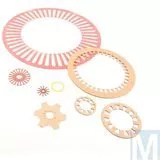
Stamped parts made of thermally conductive material
the dr Dietrich Müller GmbH has all the processing techniques to deliver the desired stampings (on a roll, in a magazine or as an individual part).